The 12-pin M8 mating face was first developed by binder in 2020. Since 2026, it has been internationally standardised as C-coding.
What is the M8-C coding?
M8-C coding (C-coded, 12-pin) is the coding for circular connectors of size M8 with twelve contacts. It carries significantly more signals over one interface than the classic M8 A-coding, without the installation space having to grow to M12. It is defined in the detail specification IEC 61076-2-104, in Germany as DIN EN IEC 61076-2-104 (VDE 0687-76-2-104).
A manufacturer of linear measuring systems needs more than eight signals for a new device generation, but does not want to increase the M8 size already in use.
binder launches a specially developed 12-pin M8 mating face with its own C-coding. The first fields of application are linear measuring systems, laboratory automation for environmental analysis and industrial cameras.
The C-coding is part of the draft for the revision of the detail specification for M8 circular connectors.
IEC 61076-2-104 is published in its 3rd edition and officially includes the C-coding for the first time.
DIN EN IEC 61076-2-104 (VDE 0687-76-2-104) is published and adopts the C-coding.
M8-C mating face: why five small coding ribs instead of one large one
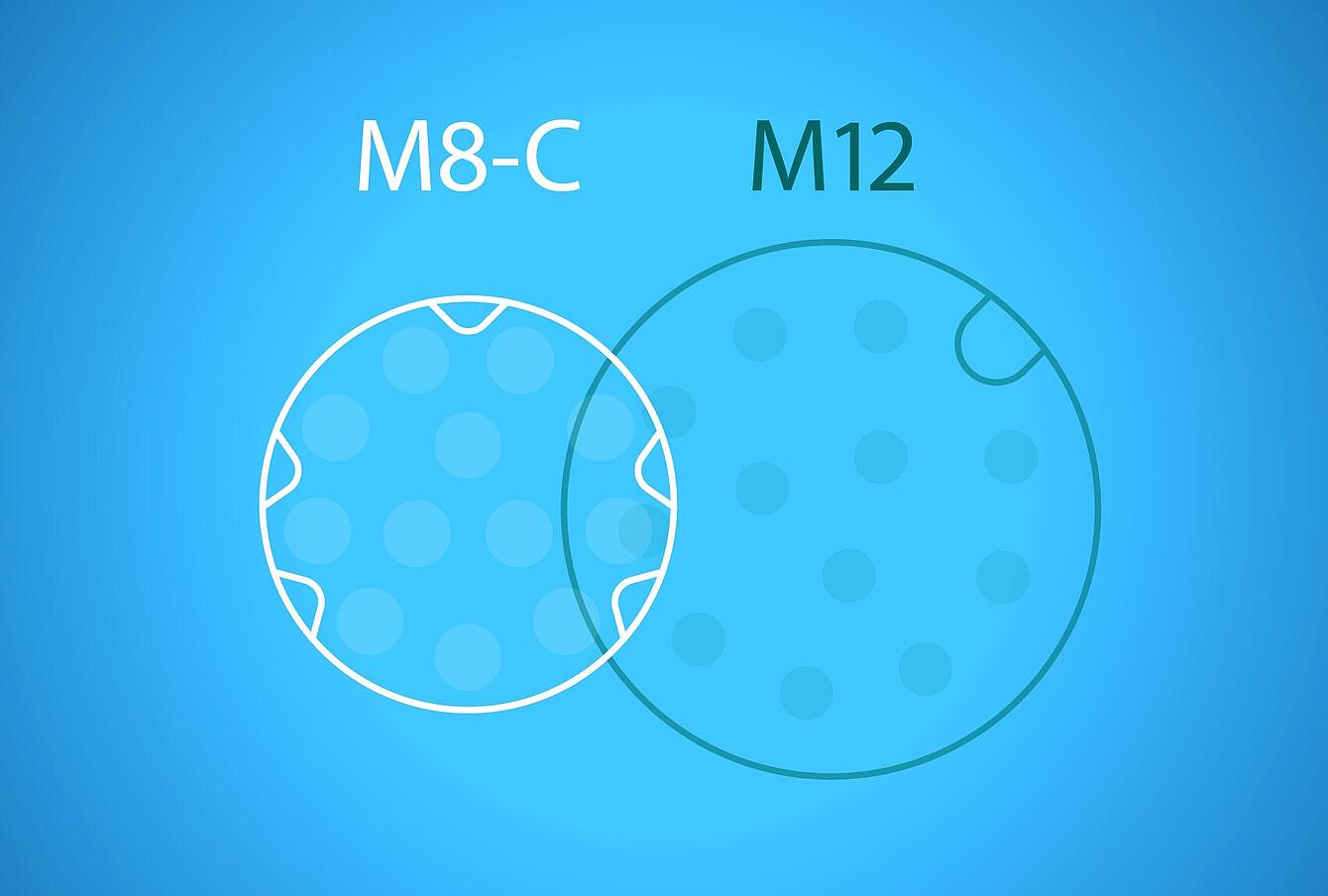
Fitting twelve contacts into an M8 diameter was the real design challenge. The established M8 codings use a single, comparatively large coding rib for orientation. With twelve symmetrically arranged contacts, there was no room for it.
binder’s solution consists of five small coding ribs. They polarise just as reliably and prevent incorrect mating, without any risk of bending the contacts, which are only 0.5 mm thin, when the free connector is mated. Manufacturing also demands precision: the M8 plastic bodies are fitted with the twelve contacts by hand, and for panel mount connectors a colour template ensures the correct assignment of the twelve fine single wires.

M8 codings compared: A-, B-, C- and D-coding
binder offers four codings for size M8, each for its own purpose: from signal and power supply to Ethernet. More on the codings from M5 to M16 can be found in the technical article Coding of circular connectors.
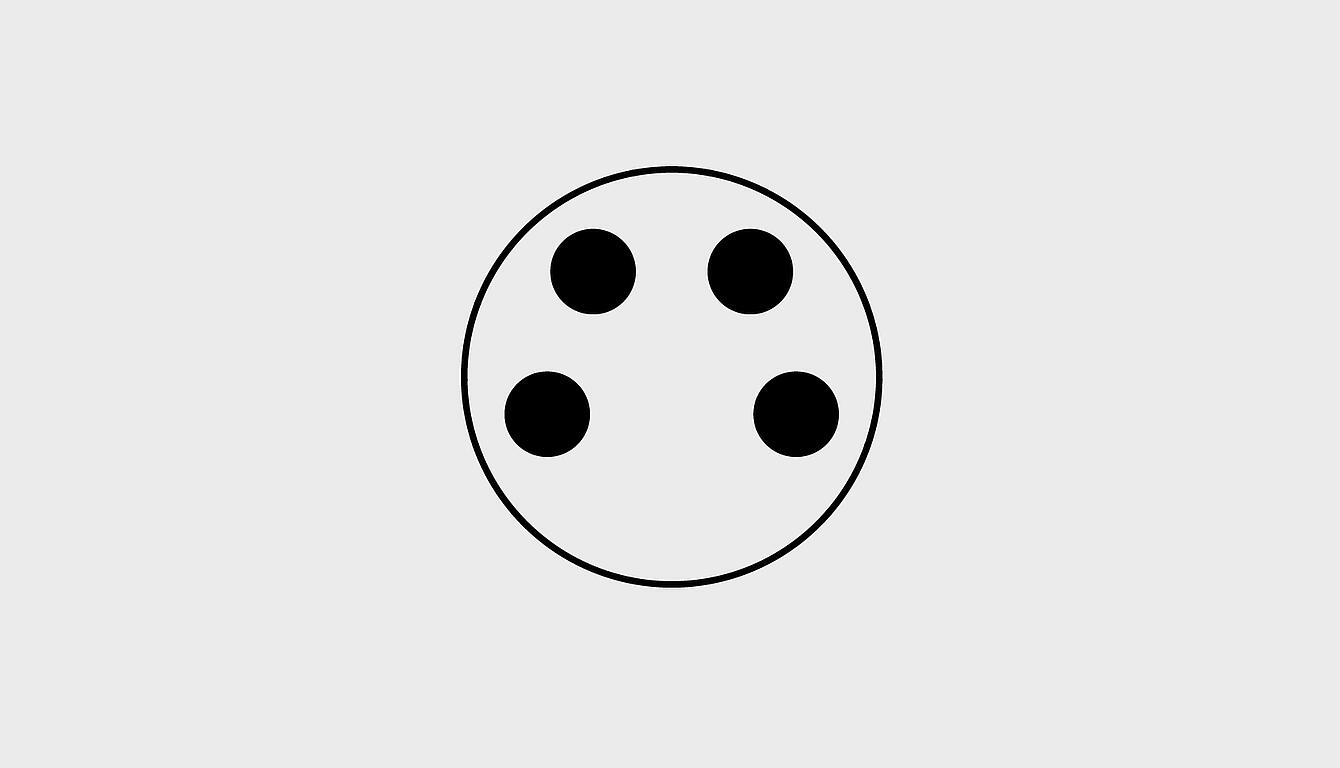
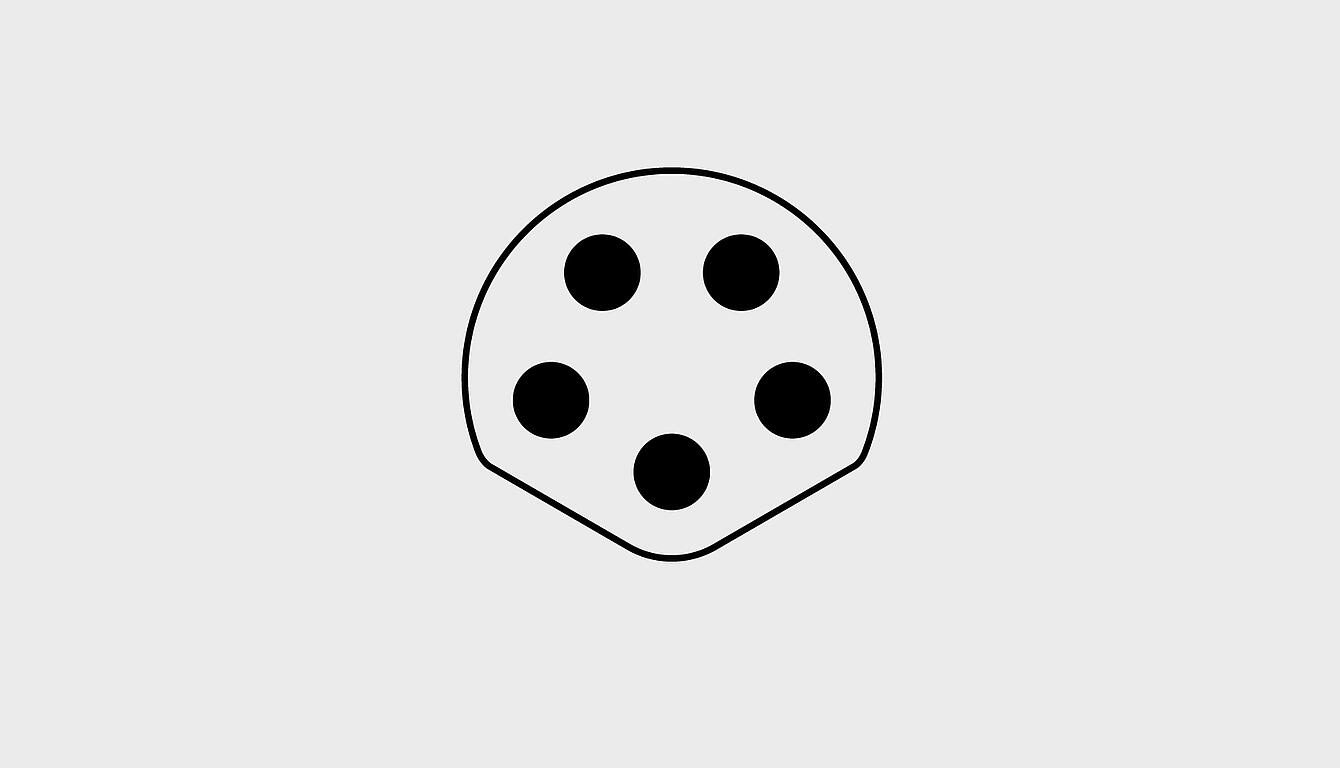

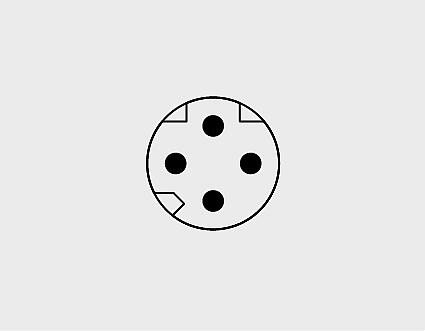
| Coding | Current | Voltage | Degree of protection | Contacts | Typical applications |
|---|---|---|---|---|---|
| A | 1.5–4 A | 30–60 V | IP65/67/68/69K | 3–8 | Power supply, signal, CAN, DeviceNet |
| B | 3 A | 30–60 V | IP67/68/69K | 5 | Signal |
| C | 1 A | 30–32 V | IP67 | 12 | Power supply, signal |
| D | 1.5–4 A | 50–63 V | IP67 | 4 | Ethernet, PROFINET |
Note: The codings cannot be mated with one another mechanically – intentionally, as this prevents interfaces with different functions from being connected by mistake.
M8-C or M12: which connector is right?
In favour of M8-C: more than eight signals at currents in the signal range, limited installation space, several interfaces close together.
In favour of M12: load currents or voltages above the signal level, larger conductor cross sections, frequent mating and unmating during operation, existing system standards.
Applications of the M8-C coding
M8-C pays off wherever many signals run over a compact interface. An example from conveyor technology: in a parcel sorting system, a single M8-C interface carries four sensor signals, four actuator signals and four additional signals between the field device and the decentralised I/O level.
- Linear and displacement measuring systems: more than eight signals without switching to M12
- Laboratory automation: environmental analysis systems with high signal density
- Industrial cameras: compact multifunction interface for image, trigger and status signals
- Conveyor and sorting technology: several field signals of a sensor/actuator module via one interface
- Robot grippers: sensors, gripper function and diagnostics in minimal installation space
Source of the standard data: DIN EN IEC 61076-2-104 (VDE 0687-76-2-104), edition September 2026 – Connectors for electronic equipment, Part 2-104: Circular connectors – Detail specification for circular connectors with M8 screw-locking or snap-locking. Coding values A/B/D according to the binder product portfolio. Information on development and market launch: binder company information. Page date: 15 September 2026.